Millard
Mariners' Museum, Uncurated Search Results
Type: Skipjack
Year: 1897
Builder:
Location: Crisfield

These records are found in the online catalog of The Mariners’ Museum and Park in Newport News, Virginia. Uncurated search results are presented to give researchers and interested readers an idea of whether the museum’s archives contain information about this vessel and whether it may be worthwhile to visit the museum’s catalog search page for further investigation. Uncurated results may be inaccurate or incomplete.
Search mode: Exact Name. Search phrase(s): "Millard". Results returned: 44. Results displayed in this table: 44.
Use these buttons to send uncurated search results to your own app or text document for further research. First, check the box for any row, or click "Select All" then uncheck any rows. Then click "Show Selections". You can then copy your selections from the text box and past them into your app.
| Fetch? | Row ID | Media | Date | Vessel | Place | Related Places | Inscription/Marks | Subject | Notes | Archive Number |
|---|---|---|---|---|---|---|---|---|---|---|
| 1 | 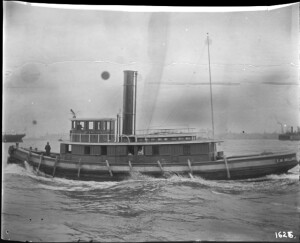 | 10/5/1895 | E. M. Millard (Steamboat : 1880). | Edward M. Millard - (tug); 1626 | Steamboats–United States.; Tugboats–United States. | Shows a port side view of a tugboat making way. Stanton's notebooks contain the following information about this item: "Oct 5 '95" | MS0094/01-#1626 | |||
| 2 | 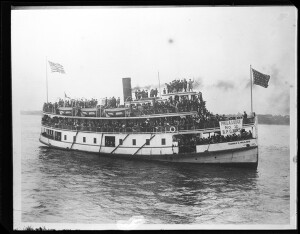 | 1883-1931 | "Thomas C. Millard" 1905 Later "Owana" | A bow side view of the Thomas C. Millard while underway. | MS0091/03.01-55#049 | |||||
| 3 | 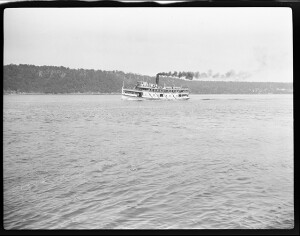 | 6/22/1924 | Thomas C. Millard (Steamship : 1905). | Steamboats.; Bodies of water.; Passenger ships. | Broadside veiw of the Thomas C. Millard under way. | MS0091/03.01-89#054 | ||||
| 4 | 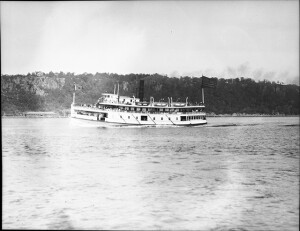 | 6/22/1924 | Thomas C. Millard (Steamship : 1905). | Steamboats.; Bodies of water.; Passenger ships. | Broadside veiw of the Thomas C. Millard under way. | MS0091/03.01-89#056 | ||||
| 5 | 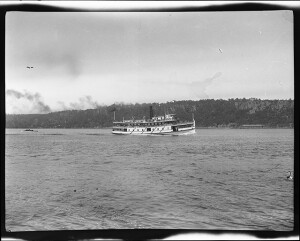 | 6/22/1924 | Thomas C. Millard (Steamship : 1905). | Steamboats.; Bodies of water.; Passenger ships. | Broadside veiw of the Thomas C. Millard under way. | MS0091/03.01-89#057 | ||||
| 6 | 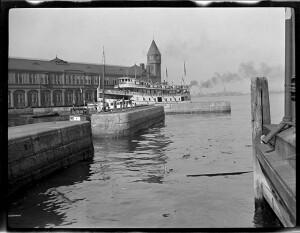 | 6/22/1924 | Thomas C. Millard (Steamship : 1905). | Steamboats.; Bodies of water.; Passenger ships. | Broadside veiw of the Thomas C. Millard at pier. | MS0091/03.01-89#055 | ||||
| 7 | 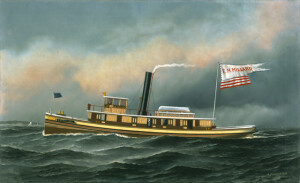 | SHORT DESCRIPTION: Port broadside view of steam tug E. M. MILLARD by Antonio Jacobsen. Signed in lower right corner. View possibly from narrows of New York harbor. Storm clouds at right. Sailing yachts dimly visible at right, other yachts and fortification visible at left. Name pennant and U.S. flag flying and Union Jack flying from jack staff. LABEL COPY: Jacobsen's roster of sketched tugboats numbers about 200, from which some 115 tugboat paintings have survived. Jacobsen allowed such a small vessel to fill his canvas, making details like the paneling show closely. Lewis Pulver owned this and other tugs painted by Jacobsen. Long-lived, as are most tugboats, this one lasted nearly sixty years. LABEL COPY: STEAM TUG E.M. MILLARD Antonio N.G. Jacobsen (Danish-American, 1850-1921) Oil on canvas, 1889 Museum Collection 33.693 QO 101 This most prolific of all American marine artists - Jacobsen's works number in the thousands - specialized in ship portraits that were noted for their accuracy and attention to detail. In some ways he was as much a maritime historian as an artist, chronicling the new steam technology that finally drove sail from the high seas. VESSEL INFORMATION- VESSEL NAME: E.M. MILLARD SHIPOWNER: JOHN E. MOORE & CO; MURSON CO.; GEORGE W. SUNDERLIN BUILDER LOCATION: ATHENS, NEW YORK VESSEL DATES: 1880-1937 | CL8625 | |||||||
| 8 | No image URL. | Millard Sheets recent paintings : __from October 6th to October 21st, 1978. | LB106044 | |||||||
| 9 | 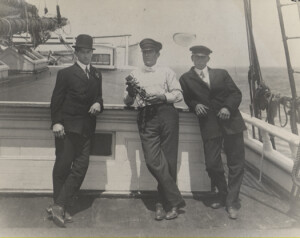 | Deck scene showing Captain Gary standing on deck holding a sextant. | P0001.016/01-#PP0432 | |||||||
| 10 | No image URL. | United States–History–Civil War, 1861-1865.; Mississippi–History–Naval operations. Civil War, 1861-1865 | From the cover: How the Mississippi was opened. | LB26229 | ||||||
| 11 | 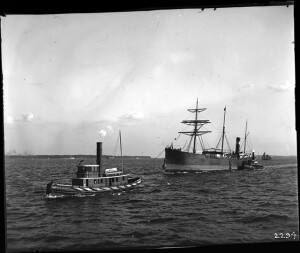 | 8/19/1896 | E. M. Millard (Steamboat : 1880).; La Hesbaye (Screw schooner : 1888).; W. Freeland Dalzell (Steamboat : 1896). | La Hesbaye; 2294 | Steamboats–United States.; Tugboats–United States. | Shows a tugboat pulling a steamship with a towline while another tugboat pushes at her port side stern. Stanton's notebooks contain the following information about this item: "Aug 19 - 96" | MS0094/01-#2294 | |||
| 12 | No image URL. | Falmouth (Mass.)–Social conditions.; Falmouth (Mass.)–Economic conditions. | Issued also as Thesis (Ph. D.) Columbia University. Includes index. | LB108676 | ||||||
| 13 | 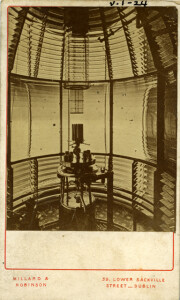 | INTERIOR OF FRESNEL LENS | P0001.012/02-APL01#024 | |||||||
| 14 | No image URL. | Sea-power–History. United States; Warships–History. United States; Marine engineering–History–United States; Weapons industry–History–United States; Shipbuilding industry–Military aspects–United States. | Naval engineering and American sea power __ __editor, Millard S. Firebaugh, managing editor, Sara H. Skolnick, production editor, Annette Carolyn Verna ; with nineteen contributors | LB84623 | ||||||
| 15 | No image URL. | NOTES: This receiver was altered by Millard and fitted with two 2.5 type 27 AC tubes (1 detector and 1 stage of audio amplification), with 45-90 volts on the plates. In standard practice a separate unit is attached to this receiver. The set is regenerative and will cover from 250 to 3000 meters. Two type 76 tubes with a 6.3 volt battery supply can be used for all DC operation. ADDITIONAL INFORMATION: See object file for drawing. | CL2842 | |||||||
| 16 | No image URL. | Great Britain–History, Naval. | Shipbuilding–England–Devon.; Shipbuilding–England–Cornwall (County).; Ships. | Ships of Devon and Cornwall : __1652-1942 __by Victor F. L. Millard | LB37452 | |||||
| 17 | No image URL. | Norfolk and Western Railway Company | Includes index. | LB23053 | ||||||
| 18 | 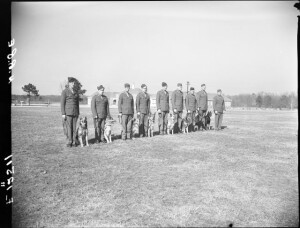 | 2/23/1945 | Bridge Camp (Va.). | Shown are dog trainers with their dogs at Bridge Camp, HRPE, Newport News, Va. Left to right: Pfc. Gerald Heinauer, 33307386, home, McKees Rocks, Pa., with Fritz; Pfc. Millard Barathlow, 33529303, home, Evertett, Pa., with Warner; Pfc. Chester Black, 37190121, home, Altooma, Iowa, with Whimpy; Pfc. Robert Stoffer, 38054392, home, Orange, Tex., with Smokey; Pvt. William Conner, 33530127, home, Cooper Hill, Va., with Val; Pvt. Harlon Schlid, 37364427, home, Fort Collins, Colo., with Sport; Pfc. Brad Carpenter, 35742283, home, Four States, W. Va., with Junior; Cpl. Donald Pfesiter, 35531809, home, R.F.D. 2, Washington, Ohio, with Doc; and Sgt. Leland Mathewson, 36257660, home, Wisconsin Rapids, Wisc. | Dogs–War use. | Shows nine men with dogs standing in a field. | P0003/01-#F-12511 | |||
| 19 | No image URL. | Great Britain–Foreign relations–China.; China–Foreign relations–Great Britain. | Britain placates Chinese sentiment. | LB54271 | ||||||
| 20 | 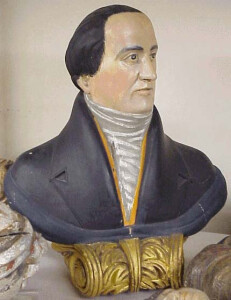 | SHORT DESCRIPTION: Male bust of Daniel Webster attached to billethead. NOTES: This figurehead can probably be attributed to a ship called DANIEL WEBSTER but it is uncertain. (Carol Olsen, 1983) The size of the Daniel Webster figurehead suggest that it could most likely have come from either of the two following vessels listed in the 1862 American Lloyds: 1. Daniel Webster, bark, 313 tons, built 1853 in Damariscotta, Maine. Port: New Haven, owner: Wyley & Bro. No dimensions given. OR 2. Daniel Webster, 263 tons, built 1853, Charlestown, Massachusetts. Port: Boston; Owner: J.H. Pearson. No dimensions given. Daniel Webster (January 18, 1782 – October 24, 1852) was an American statesman who twice served in the United States House of Representatives, representing New Hampshire (1813–1817) and Massachusetts (1823–1827), served as a U.S. Senator from Massachusetts (1827–1841 and 1845–1850) and was twice the United States Secretary of State, under Presidents William Henry Harrison and John Tyler (1841–1843) and Millard Fillmore (1850–1852). | CL3613 | |||||||
| 21 | No image URL. | Central of Georgia Railway | "The Right Way." Includes index. | LB23052 | ||||||
| 22 | No image URL. | Norfolk Southern Railway Company; Old Dominion Steamboat Company | Norfolk Southern Railroad, Old Dominion Line, and connections __ __by Richard E. Prince | LB17474 | ||||||
| 23 | No image URL. | American wireless in China. | LB43194 | |||||||
| 24 | No image URL. | Panama flag vessels. | LB52285 | |||||||
| 25 | No image URL. | Artbook : __Celebrity Beyond. | LB109156 | |||||||
| 26 | No image URL. | Great Britain. Royal Navy–History | Great Britain–History, Naval.; Severn River (Wales and England). | Warships–History. Great Britain; Warships–History. England and Wales | The warships of Gloucester (H.M. Ships Gloucester, 1654-1941), and, The Severn and naval defence __ __by Victor F.L. Millard and T. Hannam-Clark | LB36527 | ||||
| 27 | No image URL. | NOTES: Sketchbook No. 4 of pencil drawings created by Antonio Jacobsen from 1878 to 1918 for his artworks. VESSELS LISTED IN SKETCHBOOK NO. 4, 1884 BERTRAND (Bark) (Vessel Built 1880) CRAIGALLION (Screw Steamship) (Vessel Built 1881) CHATEAU LEOVILLE (Screw Steamship) (Service Dates 1881-1914 ) HEKLA (Screw Steamship) (Service Dates 1884-1910) CHATEAU MARGAUX (Screw Steamship) (1884-1889) ROBERT LOCKHART (Screw Tug) (Vessel Built 1880) CHARLES B. SANFORD (Screw Tug) (Vessel Built 1871) LOCH TAY (Screw Steamship) (1882-1884) BURSWELL (Screw Steamship) (Vessel Built 1878) S.J. LENNOX (Screw Tug) Vessel Built 1881) E.M. MILLARD (Screw Tug) (Service Dates 1880-1937) LEWIS PULVER (Screw Tug) Vessel Built 1884 ROSSEND CASTLE (Screw Steamship) (Vessel Built 1875) BROOMHAUGH (Screw Steamship) (Vessel Built 1881) HARVEY W. TEMPLE (Screw Tug) (Vessel Built 1879) LOCH GARRY (Screw Steamship) (Vessel Built 1880) ANTILLAS (Screw Steamship) (Vessel Built 1872) EDWIN HAWLEY (Screw Tug) (Vessel Built 1873) ALBANO (Screw Steamship ) JOHN E. MOORE (Steam Paddle Wheel) (Service Dates 1853-1908) ROSA (Steam Paddle Wheel Tug) (Service Dates 1853-1911) MARINER (Screw Steamship) (Vessel Built 1881) COUNSELLOR (Screw Steamship) (Vessel Built 1877) C.J. HUBBARD (Screw Tug) S. HARMONY (Screw Tug) SARAH J. WEED (Screw Tug) (Vessel Built 1874) CLAYMORE (Screw Steamship) Vessel Built 1883) BALTIC (Screw Tug) (Vessel Built 1872) IONA (Screw Steamship) THOMAS WALSH (Screw Tug) Vessel Built 1873) GLENOGLE (Screw Steamship) (Service Dates 1882-1919) KENIWORTH (Bark,4) ROSA (Steam Paddle Wheel Tug) 1853-1911 MARINER (Screw Steamship) (Vessel Built 1881) LABEL COPY: TUGBOAT E. M. MILLARD (1880-1937) Sketch, 1884 Gift of Mrs. Helen Jacobsen Chapin Sketchbook Number 4, 93.42.4 (Jacobsen Exhibit: "Painted Ships on Painted Oceans" 10/24/1994 Gallery 15, Section 623A) | CL28277 | |||||||
| 28 | 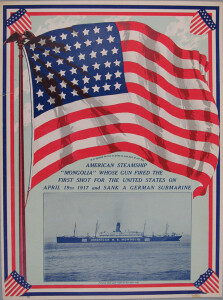 | VESSEL INFORMATION - VESSEL NAME: MONGOLIA OF NEW YORK VESSEL TYPE: AMERICAN STEAMSHIP SERVICE DATES: 1904-1946 SHIPBUILDER: NEW YORK SHIPBUILDING CO. BUILDER LOCATION: CAMDEN, NEW JERSEY SHIP OWNER: PACIFIC MAIL STEAMSHIP CO. (1911-1915, ATLANTIC TRANSPORT CO. 1915 ALL SHIP'S NAMES: PRESIDENT FILLMORE (1929), PANAMANIAN (1940) SCRAPPED: SHANGHAI 1946 SISTER SHIP: MANCHURIA VESSEL DIMENSIONS: 600' x 65', 113,635 tonnage | CL10104 | |||||||
| 29 | 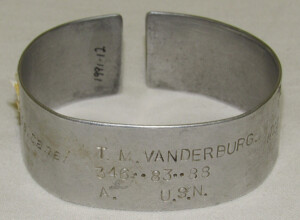 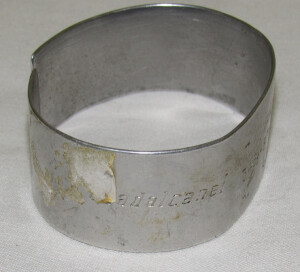 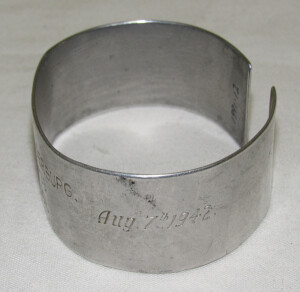 | SHORT DESCRIPTION: Metal cuff-style bracelet with the name, service number, date, location, service affiliation, and blood type of a sailor believed to have been on Guadalcanal during the battle on August 7th, 1942. NOTES: Troy Millard Vanderburg was a Navy Corpsman assigned to the 1st Marine Batallion. The donors identified this piece as an identification bracelet, possibly a memorial piece. It has since been determined that Vanderburg survived the war and the size of the bracelet suggests it may have been a sweetheart bracelet. | CL23434 | |||||||
| 30 | No image URL. | Alexander Hamilton (Side wheel steamer : 1924). | Shipbuilding–Specifications. | "Contract dated December 28, 1922." "Builders' Hull no. 4217." | LB29093 | |||||
| 31 | No image URL. | Influence of Arctic operations on future ship design. From the Journal of American Society of Naval Engineers, Aug. 1947. | LB74809 | |||||||
| 32 | No image URL. | Richmond, Fredericksburg, and Potomac Railroad | Includes index. | LB23054 | ||||||
| 33 | No image URL. | Arctic regions–Research. | Underwater exploration–Arctic regions.; Remote submersibles–Arctic regions. | Autonomous research under the ice. | LB89040 | |||||
| 34 | No image URL. | Eric the Red : __the vikings sail the Atlantic | LB99843 | |||||||
| 35 | No image URL. | Japan–Foreign relations–United States; United States–Foreign relations–Japan; United States–Colonial question; Pacific Ocean–Commerce | Eastern question (Far East) | America and the Far Eastern question : __an examination of modern phases of the Far Eastern question, including the new activities and policy of Japan, the situation of China, and the relation of the United States of America to the problems involved __by Thomas F. Millard | LB8914 | |||||
| 36 | No image URL. | Fishes–Puerto Rico; Fisheries–Puerto Rico. | At head of title: U.S. Commission of Fish and Fisheries. George M. Bowers, commissioner. Issued in advance of the full report, published in the Bulletin of the United States fish commission, vol. xx for 1900. Washington, 1902. 2 v. | LB22932 | ||||||
| 37 | No image URL. | Merrimack (Frigate : 1856-1860).; Virginia (Ironclad : 1862). | Hampton Roads, Battle of, Va., 1862. | Typewritten. From a typed copy in the U.S. Navy Department. Photostat of a letter by John Luke Porter relative to the conversion of the Merrimac into an ironclad, and the defenses of Portsmouth. Reproduced from a photostat in possession of C.I. Millard, Norfolk, Va., May 22, 1936. | LB3118 | |||||
| 38 | 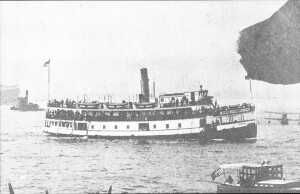 | 1883-1931 | "Owana"/1905/ex "Thomas C. Millard" | Broadside view of a steamer underway in harbor with passengers. | MS0091/03.01-42#086 | |||||
| 39 | No image URL. | Alabama (Screw sloop : 1862).; Confederate States of America. Navy–Officers.; United States. Navy–Officers.; Shark (Schooner : 1821). | United States–History–Naval operations. Civil War, 1861-1865 | Spies–History–Civil War, 1861-1865. United States; Shipbuilding contracts–Confederate States of America. | This collection consists of spy reports, commissions, correspondence, a scrapbook of obituaries, and the "Original Contract for the Building of the Confederate States Steamship Alabama." The spy reports by Matthew Maguire include specific information pertaining to the CSS Alabama. The correspondence in this collection shows the relationship between Bulloch and members of his family as well as other officers including Francis Lawley, R. J. Armstrong, and Neil Harrison. These letters span from Bulloch's time serving in the Navy in 1847 to after his death in 1901. Also included are Bulloch's warrant as master and his Confederate States naval commission as commander. The warrant is dated 17 January 1853 and is signed by President Millard Fillmore; Bulloch's Confederate commission is dated 17 January 1862 and is signed by President Jefferson Davis. | MS0283 | ||||
| 40 | 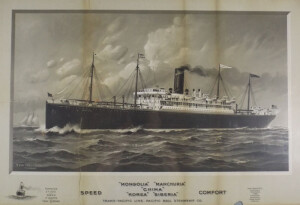 | VESSEL INFORMATION-- VESSEL NAME: MONGOLIA SHIP NUMBER: VESSEL TYPE: steel twin screw schooner SERVICE DATES: 1904 SHIP BUILDER: New York Ship Bilding Company BUILDER LOCATION: Camden, New Jersey VESSEL HISTORY: Vessel was originally contracted for by the Atlantic Transport co. and was to have been called the MINNELORA, but was purchased by the Pacific Mail Steamship Co. while on the stocks. Vessel was used on the San Francisco trans-Pacific service unti the company was forced out in 1915 with popularity. She was then sold to the International Mercantile Marine and used on the Atlantic Transport Serice until the re-establishment of the Panama Pacific LIne hwne she was placed in the New York, and San Francisco service. She was sold to the Dollar Line in 1929 and reconditioned and renamed PRESIDENT FILLMORE. SHIP OWNERS: Pacific Mail Steamship Co. ENGING BUILDER AND LOCATION: VESSEL DIMENSIONS: 600'(length) x 65' 3"(beam) x 23'1"(depth); 13,638 tons; 2-4 cylinder quadruple expansion engines with cylinders 30, 43, 63, & 89 with a 60" stroke & 11,000 horse power ALL SHIP NAMES: (1) MONGOLIA (SCREW SCHOONER: 1904-1930); (2) USS MONGOLIA (TRANSPORT: 1918-1919); (3) PRESIDENT FILLMORE (SCREW SCHOONER: 1931-1940); (4) PANAMANIAN (SCREW STEAMSHIP: 1941-1948). | CL19494 | |||||||
| 41 | 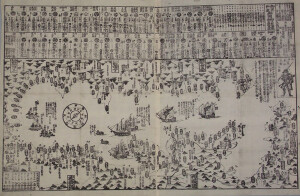 | NOTES: Title: No general title, Across top part of print, in two rows, are the names, crests, standards and annual income in terms of rice of daimio assigned to coastal guard duty during Perry's second visit to Japan. (Insert, upper right corner of main part of print) A man of North America. (Left of insert) It is 1854 years since the United States of North America was founded and it is 78 years since they became independent. The country was populated by those who came over there from Europe. The king of the country is called Burishitento Hirurato Serimore (President Millard Fillmore). The commander in chief of the squadron, envoy and commodore of the navy is Machuse Herure (Matthew Perry) who came to Japan with a written request. He came to Uraga in the 6th month, 6th Year of Kaei (1853) and came further in to Yokohama on the 11th day, lst month, of the following year. NOTES: [Barry Lawrence Ruderman Antique Maps, May 2021] Japanese newspapers began in the 17th century as yomiuri (読売、literally "to read and sell") or kawaraban (瓦版, literally "tile-block printing" referring to the use of clay printing blocks), which were printed handbills sold in major cities to commemorate major social gatherings or events. These sheets were often printed anonymously. The kawaraban publishers served as a crucial vector for the transmission of information about Commodore Mathew Perry's opening of Japan. During the Edo Period (1600-1868), the arriving European vessels were called kurofune (Black Ships). That time was characterized by great social upheaval, and intense public interest in the agents of the outside world arriving in Japan. Anna Wada, in "About Kawaraban", Perry in Japan A Visual History, gives background on the kawaraban: "The kawaraban took up a range of topics, including natural disasters, superstitious happenings, murders, and less commonly, political satire. Printers chose topics more to entertain and satisfy the readers’ curiosity than to educate them. Visual components such as illustrations, diagrams, and maps attracted the people to the print and helped them to understand the text, as well as sometimes offering additional information. Throughout the Edo period the shogunate repeatedly restricted printing for a mass audience, particularly seeking to avoid rumors and political commentary. By the time the Black Ships [i.e., Perry’s fleet] arrived at the end of the Edo period, however, the system of censorship could not keep up with the number of prints in circulation. The increase in publications coincided with the spread of literacy in both urban and rural areas." | CL17997 | |||||||
| 42 | 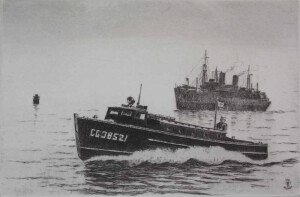 | SHORT DESCRIPTION: Black and white etching by Charles J. A. Wilson [1880-1965] titled "Picket Boat". Port view of picket boat CG 38521 [built circa 1942], underway, with unidentified cargo vessel in the background. Buoy marker at left. Signed in pencil at lower left "Picket Boat"; at lower right corner "CJA Wilson". The US Coast Guard Picket Boat CG38521 operated in Boston Harbor during World War II. NOTES: [excerpts of an article written by C. Edmuch Pyne, CDR USCGR Ret] According to the newsletter of the Cottage Park Yacht Club in Winthrop, Massachusetts, March 2009, during the summer of 1942 the Cottage Park Yacht Club served as a temporary US Coast Guard Headquarters. On February 19, 1941 Congress had authorized the formation of a civilian volunteer corps to assist the Coast Guard. Three club members formed Flotilla 1-412. Every member of the yacht club who owned a motor boat enrolled it in the US Coast Guard Temporary Reserve and began taking on the duties previously handled by the regular Coast Guard. The Flotilla gained additional government recognition when the 39-foot motor sailor AURAL 2 was designated an official C.G.R. patrol boat and became CGR1020. By November 1942, the following members of CPYC had enrolled in the Temporary Reserve (TR); Ken and John Magoon, Randy Foote, John McElroy, Al Dodson, Paul Gaffney (Judy’s Dad), Ted McCarthy and Millard Smith, to name a few. The CPYC Board of Directors permitted the C.G.TR to use the Club as their Headquarters. Regular watch lists were established on a twenty-four basis. Three times a day CG1020 pick-up the TRs at the Club’s pier and transported them to the Boston Floating Lifeboat Station moored at Deer Island Light, where they relieved their boarding assignments. When an incoming vessel answered the challenge of the outer examination vessel, located on station at the end of the North Channel, off Nahant, word was flashed to the Harbor Entrance Control Post. This information, in turn, was relayed to the Lifeboat Station with instructions to board the incoming vessel as soon as it came through the submarine net at the entrance of the inner harbor (Deer Island Light). Fishing vessel crew lists were checked for possible spies or espionage agents placed aboard by submarines. Vessels were not allowed to carry excess food or fuel into or out of the harbor. By early 1943, the ranks of Flotilla 1-412 swelled to over four hundred. A radio telephone wireless station was established in the Club to communicate with Coast Guard Headquarters in Boston and with the Floating Lifeboat Station. Watch lists were posted in the lobby of the Club. Every eight hours volunteers (TR’s) entered the Club and walked to the pier to board the CG38521 or two 50 foot cabin cruisers appropriated by the Government for Coast Guard duty. By late 1943 and early 1944, the Flotilla had grown to its high of 650 members and was the largest TR organization in the country. NOTES: Charles J. A. Wilson was born in 1880 in Glasgow, Scotland. He came to America as an infant and in his teens moved to Newton, Massachusetts. Wilson was a prolific, self-taught, marine artist who gained much of his experience from working in the Boston shipyards. He worked as an artist for Bethlehem Shipbuilding in East Boston, etching their ships from blueprints. During the World War I, Wilson spent two years in France. After the war he was commissioned to paint and etch American ships and marine views. During World War II, Wilson worked in Boston as an official Coast Guard artist. He was a member of the Boston Society of Printmakers, and exhibited with Pennsylvania Academy of the Fine Arts, Society of American Etchers and the Currier Gallery. | CL17262 | |||||||
| 43 | 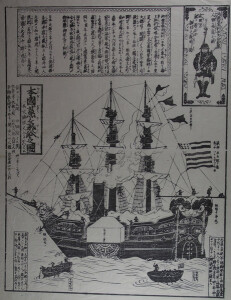 | NOTES: (Small box in lower right corner) This is said to be a flag ship, all painted vermillion. Below the middle deck down to the draft (water’s edge), the side is covered with steel plate. At the bow it has a golden phoenix and at the stern a lion’s head. The portholes have glass windows. Out of eight ships they had, this one visited this country. (Note: the last sentence may alternatively be translated to read: Out of eight ships of this type, this one came to Japan). (Small box, low left corner) A large vessel without paddle wheels is called the Suskehand fune (Susquehanna ship). That is 65 ken long and has a crew of 500. The entire ship is pained black. That steamer is different from the others. It makes a striking picture when it steams towards the sun. (Middle left, adjacent to title box) The ship (meaning the one pictured) is 35 ken long, 15 ken wide at the widest point; it has a smokestack l jo and 8 shaku long and three sailing masts each of which has three cross ties for the sails. The main battery consists of six cannon while the secondary battery has 18 guns. The steel paddles are 5.5 ken in diameter and 2 ken thick. The part of the paddle below the water is about 4 sahaku. Total crew about 400. (Inscriptions about the ship) At the steer: There are two rope ladders. Near flag: A flag, red and white striped; in the corner red crosses. Above , near pennant: A small red and white flag. Paddle wheel: This part is covered with white leather. At the bow: The anchor is made of iron. Right lifeboat: Boat carved out of wood. Left lifeboat: Boat. (Upper right corner) Portrait of a man of the Great United States of America. He wears a black coat, carries a sword on his back, and hold a gun with bayonet. (Large box at top of print) North America lies to the northeast of Japan. A harbor called California is 5,000 ri across the sea from Japan. To the north of this harbor is a large city called Washington. Since the foundation of the country 1854 years have passed. People in that country came from Europe. The country has been independent 78 years. The name of the king is President Hiruraruto Serumore (Millard Fillmore). In the 6th month, 6th year of Kaei (1853), Commodore Perry, by order of the king and carrying his letter, came to Uraga. Again on the 11th day, first month, 7th year of Kaei (1854), he came on a ship carrying with him some requests. His ships entered the sea of Kaishikawara (off Yedo) on the night of the 27th and after a few days they withdrew to Yokohama off the coast of Homoku near Kanazawa. He had an interview with our officials. (Final paragraph left side of large box) On the 5th day, 1st month, llth year of Tempo (1841), five fishermen including Mannosuke (later known as Nakahama Manjiro), in a fishing boat from Nakahama, Hatakori, Tosa daimiate, drifted across the Pacific to North America. They stayed there for 13 years and in the 5th year of Kaei (1852) returned to Japan, landing at Nagasaki. They are still alive. NOTES: [Barry Lawrence Ruderman Antique Maps, May 2021] Japanese newspapers began in the 17th century as yomiuri (読売、literally "to read and sell") or kawaraban (瓦版, literally "tile-block printing" referring to the use of clay printing blocks), which were printed handbills sold in major cities to commemorate major social gatherings or events. These sheets were often printed anonymously. The kawaraban publishers served as a crucial vector for the transmission of information about Commodore Mathew Perry's opening of Japan. During the Edo Period (1600-1868), the arriving European vessels were called kurofune (Black Ships). That time was characterized by great social upheaval, and intense public interest in the agents of the outside world arriving in Japan. Anna Wada, in "About Kawaraban", Perry in Japan A Visual History, gives background on the kawaraban: "The kawaraban took up a range of topics, including natural disasters, superstitious happenings, murders, and less commonly, political satire. Printers chose topics more to entertain and satisfy the readers’ curiosity than to educate them. Visual components such as illustrations, diagrams, and maps attracted the people to the print and helped them to understand the text, as well as sometimes offering additional information. Throughout the Edo period the shogunate repeatedly restricted printing for a mass audience, particularly seeking to avoid rumors and political commentary. By the time the Black Ships [i.e., Perry’s fleet] arrived at the end of the Edo period, however, the system of censorship could not keep up with the number of prints in circulation. The increase in publications coincided with the spread of literacy in both urban and rural areas." | CL17998 | |||||||
| 44 | 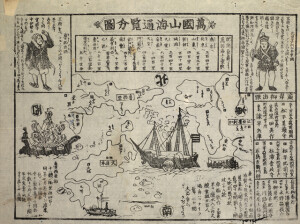 | NOTES: (No.7): Bankoku Sankai Tsuran Bunzu (Map of the world showing the countries and seas) Explanatory notes: This print refers to the arrival of American ships at Yokohama and Russian ships at Nagasaki in 1854. Map show Japan in center with Yedo - later Tokyo - incorrectly on the north coast of Honshu and Osaka island in the western half of Honshu. America lies to the right with the city of Washington under the name of the continent. About one inch east of the top of the main mast of the American paddle wheel ship is a "city " named "Oregon Shu" (Oregon State). North of that is another "city" named "Nova Worussia" (New Russia), on the Asiatic continent, the place names include Mongolia, Tartaria, Korea, et cetera. Beneath the title is a box which contains distances from Nagasaki to other parts of the world. For example, it is noted that the distance to America is more than 5,000 ri (l ri equals 2.44 miles). Translations: (Box in upper right corner with soldier holding sword) The United States of North America. The capital is called Washington. Since the foundation of the country 1853 years have elapsed. When the Japanese brothers arrived in that country after having drifted across the sea during the Kanei era, they had no king in that country. It is now 77 years since the country became independent. The country is now a republic. In the 9th month of the Cow Year of Kaei, the Naval Commodore Matthew Perry came to Uraga in Soshu by order of President Millard Fillmore and brought with him a presidential message. (Note: Reference above to the Kanei era (1624-43) is obviously incorrect and possibly the Kwansei era (1789-1800) was meant. However, the first record of Japanese being picked up in this manner by Americans was in 1806 which is in the Bunkwa era). (Box in upper left corner with soldier saluting) Russia. The capital is called Petersburg. As in the case of America, the country was founded 1853 years ago. During the Kwansei era 17891800) there came a Russian boat (or boats) to Matsumai (Hokkaido), bringing on board a Japanese fishermen from Ise named Kota and Isokichi. Again, during the 9th month of the first year of Bunkwa (1804) Japanese fishermen from Sendai , who had been found adrift, were carried back to Japan on board a Russian ship. The Russians asked for the right to trade. (Three square boxes on right under box with American soldier) Listed are the daimio who were assigned to guard the coast, presumably at the time of Perry’s visits. (Lower right under American ship and long boat) This vessel came to Uraga on the 2nd day, 7th month, 6th (Cow) Year of Kaei and left on the 12th of the same month. There were two steamships and two frigates. A boat (presumably the one depicted) is 45 ken long and 32 sic ken wide. In the bow and stern there are six large cannon mounted in addition to 28 smaller guns. The paddle is made of steel and is more than five ken in diameter, three or four shaku of which is under water. The wheel is about 2 ken wide. The crew is 500. A small boat –battera---is 20 kne long (this refers to the longboat). The captain himself handles the steering wheel. (Lower left corner): A Russian ship with 12 small boats. The crew 400. Came to Nagasaki in the 7th month of the same year as the American ships (came to Uraga). The ship is 35 ken long, about 12 ken wide at the widest point and more then 10 ken high. There are 12 sails, 32 large cannon, 36 small cannon. The prow is 13 ken long. Note: l ken equals 6 shaku or l.99 yards; thus almost six feet. 1 shaku equals 0.94 foot. NOTES: [Barry Lawrence Ruderman Antique Maps, May 2021] Japanese newspapers began in the 17th century as yomiuri (読売、literally "to read and sell") or kawaraban (瓦版, literally "tile-block printing" referring to the use of clay printing blocks), which were printed handbills sold in major cities to commemorate major social gatherings or events. These sheets were often printed anonymously. The kawaraban publishers served as a crucial vector for the transmission of information about Commodore Mathew Perry's opening of Japan. During the Edo Period (1600-1868), the arriving European vessels were called kurofune (Black Ships). That time was characterized by great social upheaval, and intense public interest in the agents of the outside world arriving in Japan. Anna Wada, in "About Kawaraban", Perry in Japan A Visual History, gives background on the kawaraban: "The kawaraban took up a range of topics, including natural disasters, superstitious happenings, murders, and less commonly, political satire. Printers chose topics more to entertain and satisfy the readers’ curiosity than to educate them. Visual components such as illustrations, diagrams, and maps attracted the people to the print and helped them to understand the text, as well as sometimes offering additional information. Throughout the Edo period the shogunate repeatedly restricted printing for a mass audience, particularly seeking to avoid rumors and political commentary. By the time the Black Ships [i.e., Perry’s fleet] arrived at the end of the Edo period, however, the system of censorship could not keep up with the number of prints in circulation. The increase in publications coincided with the spread of literacy in both urban and rural areas." | CL17994 |
Created 2026 by Don Barker, CBMM volunteer, for the Chesapeake Shipbuilding Project. shipbuilding@sailingworkboats.es